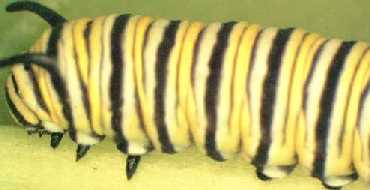
 Third Instar

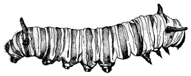 Appearance: The black and yellow bands on the abdomen
of a third instar larva are darker and more distinct than those of the second
instar, but the bands on the thorax are still indistinct. The triangular
patches behind the head are gone, and have become thin lines that extend below
the spiracle. The yellow triangle on the head is larger, and the yellow
stripes are more visable. The first set of thoracic legs are smaller than
the other two, and is closer to the head.
Appearance: The black and yellow bands on the abdomen
of a third instar larva are darker and more distinct than those of the second
instar, but the bands on the thorax are still indistinct. The triangular
patches behind the head are gone, and have become thin lines that extend below
the spiracle. The yellow triangle on the head is larger, and the yellow
stripes are more visable. The first set of thoracic legs are smaller than
the other two, and is closer to the head.
Third instar larvae usually feed using a distinct cutting motion on leaf edges. Unlike first and second instar larvae, third (and later) instars respond to disturbance by dropping off the leaf and curling into a tight ball. Monarch biologist Fred Urquhart called this behavior "playing possum."
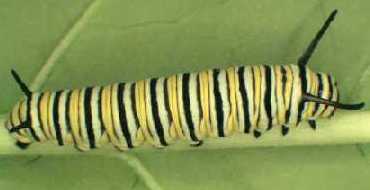 Fourth Instar
 Body length: 13 to 25 mm
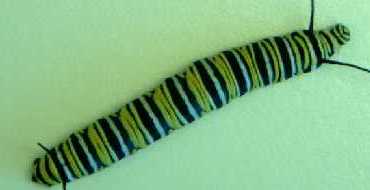 Fifth Instar
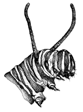 Body length: 25 to 45 mm
Fifth instar monarch larvae often chew a shallow notch in the petiole of the leaf they are eating, which causes the leaf to fall into a vertical position. They move much farther and faster than other instars, and are often found far from milkweed plants as they seek a site for pupating.
| MLMP | Egg thru 2nd instar |